| From | Time (HH:MM) |
|---|---|
| Dakshineswar to Kavi Subhash | 07:00 |
| Kavi Subhash to Dakshineswar | 07:00 |
City metro guide
Kolkata Metro Routes, Fares & Station Guide
A dedicated landing page for Kolkata Metro with route planning, fare slabs, station details, and visitor-friendly internal links.
Select Guide Section:
Plan a route in Kolkata Metro
The city is preselected for faster route planning and stronger SEO relevance.
Quick Transit Stats
Stations
37
Stations indexed
Wait time
5 min
Average interval
Transfer
6 min
Penalty penalty
Fare Slabs
5
Ticket segments
Train Timetable
First and last train information for Kolkata Metro route pairs.
Last train
Night departures
| From | Time (HH:MM) |
|---|---|
| Dakshineswar to Kavi Subhash | 21:30 |
| Kavi Subhash to Dakshineswar | 21:30 |
Metro lines & stations
A cleaner network overview with colored line chips and station lists.
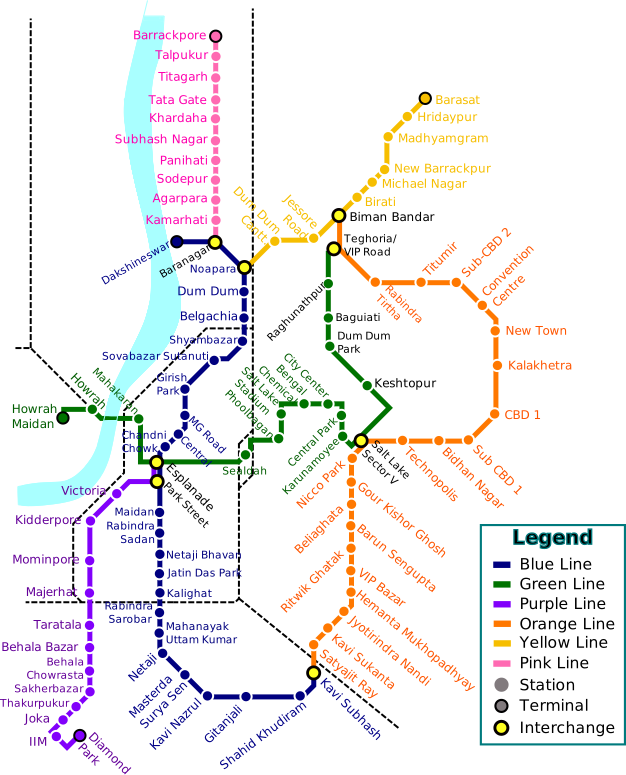
Line 1 - Blue Line
26 stations connected on this corridor
Dakshineswar
Baranagar
Noapara
Dum Dum
Belgachia
Shyambazar
Shovabazar Sutanuti
Girish Park
Mahatma Gandhi Road
Central
Chandni Chowk
Esplanade
Park Street
Maidan
Rabindra Sadan
Netaji Bhavan
Jatin Das Park
Kalighat
Rabindra Sarobar
Mahanayak Uttam Kumar
Netaji
Masterda Surya Sen
Gitanjali
Kavi Nazrul
Shahid Khudiram
Kavi Subhash
Line 2 - Green Line
12 stations connected on this corridor
Salt Lake Sector V
Karunamoyee
Central Park
City Centre
Bengal Chemical
Salt Lake Stadium
Phoolbagan
Sealdah
Esplanade
Mahakaran
Howrah
Howrah Maidan
Frequently searched stations
Select a station to view details.
Popular links
Internal navigation links.
Network guide
Kolkata Metro — commuter guide
Essential information for planning travel on Kolkata Metro.
Kolkata Metro Network
Kolkata Metro is India's first metro system, inaugurated in 1984. It now operates four lines. The Blue Line (Line 1, North-South) was the inaugural corridor and runs underground from Dakshineswar to New Garia. The Green Line (Line 2, East-West) is the most engineering-intensive line in India — it crosses under the Hooghly River and includes Howrah Metro Station, which at 33 metres below street level is the deepest station in the country. The Orange Line (Line 6, Joka–Esplanade) and the Purple Line (Line 3, New Garia–Airport) are both partially operational.
Key areas connected
Dakshineswar temple complex (Blue Line northern terminal), Dum Dum (Blue Line, airport area feeder), Shyambazar (residential north Kolkata), Rabindra Sarani (heritage and cultural zone), Esplanade and Park Street (central commercial), Rabindra Sadan (cultural precinct), Kalighat temple access, Tollygunge (southern suburban hub), Howrah (via Green Line, across the Hooghly), Sealdah (eastern rail terminus, Green Line), Salt Lake Sector V (IT hub, Green Line east).
Airport, railway and bus connectivity
Howrah Junction Railway Station — one of the busiest rail terminals in India — is adjacent to Howrah Metro Station on the Green Line, accessible via underground pedestrian access. Sealdah Metro Station (Green Line) provides underground access to Sealdah Railway Station's main terminal. Dum Dum Metro Station on the Blue Line sits near Dum Dum Junction Station and is the closest metro point to Netaji Subhas Chandra Bose International Airport, approximately 2 km from the domestic terminal.
Major interchange stations
Esplanade is the most significant interchange in the Kolkata Metro network — where the Blue Line (North-South) and the Green Line (East-West) meet, and the planned Orange Line will also converge here. Dum Dum serves as an interchange between the Blue Line and the upcoming Purple Line (New Garia–Airport). The Esplanade–Dharamtala junction above street level is also the city's largest central bus terminus.
Popular route searches
Howrah to Salt Lake Sector V — Green Line through the Hooghly underwater tunnel, entirely underground. Dakshineswar to Esplanade — Blue Line, pilgrimage corridor. Sealdah to Howrah — Green Line direct (avoids Howrah Bridge traffic). Dum Dum to Kalighat — Blue Line, north-south corridor. Tollygunge to Park Street — Blue Line, south to central.
Commuter insights
The Green Line's Hooghly river section uses a shield-bored tunnel at 13 metres below the riverbed — a unique engineering feat in Indian metro history. Howrah Metro Station required excavating through alluvial soil at 33 m depth, making it the deepest station built in India. Blue Line fares remain among the lowest in any Indian metro. The Dakshineswar–Dakshineswar extension opened in 2021, connecting the famous Kali temple for devotees.
Frequently Asked Questions (FAQs)
Essential questions answered about the Kolkata Metro network.
How deep is Howrah Metro Station on the Green Line? ▼
Howrah Metro Station on the Green Line (East-West corridor) is 33 metres below street level — making it the deepest metro station in India. The depth was necessary to bore safely through the alluvial soil below the Hooghly riverbed at the corresponding underwater tunnel section.
Which metro station connects to Sealdah Railway Station? ▼
Sealdah Metro Station on the Green Line (East-West corridor) provides underground pedestrian access to Sealdah Main Railway Terminal — the primary terminal for trains to North Bengal, Bangladesh border, and the South Bengal coastal districts. The pedestrian connection is inside the fare-paid zone at the station.
Which station is the interchange between the Blue Line and Green Line? ▼
Esplanade is the interchange station where Kolkata Metro's Blue Line (North-South, Line 1) and Green Line (East-West, Line 2) meet. Esplanade is also the city's largest central bus terminus, located on the border of the BBD Bagh government district and Park Street commercial zone.
When did Kolkata Metro first begin operations? ▼
Kolkata Metro inaugurated partial service in October 1984, making it the first metro system in India. The Blue Line (North-South) initially ran between Esplanade and Bhowanipore, expanding gradually over subsequent decades to its current Dakshineswar–New Garia alignment.
Does Kolkata Metro connect to the international airport? ▼
The closest metro point to Netaji Subhas Chandra Bose International Airport is Dum Dum Metro Station on the Blue Line, approximately 2 km from the domestic terminal. A dedicated metro-to-airport link is not yet operational; road transport (auto or cab) bridges the final gap from Dum Dum Metro.